REPORT ON ALTERNATIVE DISPUTE RESOLUTION AS AT 30 JUNE 2026

During the first six months of 2026, as many as 534 consumers went through the entire conciliation process: application filing, negotiation, final resolution ó a solution accepted by both parties in 332 cases, or reached an amicable settlement directly with their banks/NBFIs, having first approached ABDRC (in 202 cases).

In the six three months of the year, 59 court cases were closed because the parties wanted and managed to find an amicable solution with the help of ABDRC.


The number of applications received in the first six months of the year (2,060 applications) shows a visible increase compared to H1 2025 (1,464 applications), i.e., up approximately 40% YoY. Some consumers continued to experience genuine difficulties in making the due payments, and these justified circumstances required identification of solutions to rebalance the contractual obligations (with the applications being submitted directly to creditors, or via ABDRC).

Of the total number of applications received before the end of H1 2026, 1,458 applications addressed different issues in relation with banks (1,095 in H1 2025), whereas 602 applications concerned different issues in relation with NBFIs (369 in H1 2025).

Thus, the share of applications intended at NBFIs slightly increase above last year’s reference period: from 25% of total/H1 2025, up to approximately 29% of total/H1 2026.

Moreover, the share of applications intended at banks observes a slight decrease in the two periods subject to comparison: 75% of the total/at the end of H1 2025, and 71% of the total/H1 2026.

In this statistical slot, we need to highlight also that, in the six months of this year, the number of applications for deregistration from the Credit Bureau (CB) observed a slight increase YoY; however, their share has dropped out of total (when applied to this year’s reporting base, i.e., 40% higher than the same period of last year).

At the end of H1 2026, we see 340 applications for deregistration from the CR (218 intended at banks + 122 intended at NBFIs), while the number of this type of applications recorded at the end of H1 2025 was 321 (156 intended at banks + 165 intended at NBFIs). It should be recalled that most of the applications aimed at deregistration from the Credit Bureau are closed because there is a special law in place for these cases, and this prevents such negotiations.

The number of cases formed at the end of H1 2026 reached 395, all of which concerned banks. By way of comparison, 415 casefiles were formed in the first six months of 2025. Of the casefiles formed this year and settled until the end of the reference period, 332 concluded with a resolution (the parties accepted the solution proposed by the conciliator), while other 26 cases are still being processed (at the end of H1 2026). In 32 cases, one of the parties rejected the solution proposed by the conciliator and a report was issued, whereas in 5 cases, one of the parties withdrew.

The number of resolutions handed down in the first half of this year is 332, compared to the figure reported for the same period of last year, i.e., 373 resolutions (during the two periods under review, being H1 2026 and H1 2025, the share of resolutions out of the total solutions is 91%/H1 2026 and de 97%/H1 2025).

Furthermore, before the end of the H1 2026, 202 applications were settled amicably by traders after the respective cases having been referred to ABDRC (traders negotiated directly with consumers), broken down as follows: 166 applications settled amicably with banks, and 36 applications settled amicably with NBFIs (H1 2025: 123 applications settled directly, of which 91 by banks and 32 by NBFIs). Virtually, compared with the same period last year, the number of applications settled amicably by banks has almost doubled.


At the end of H1 of this year, we counted 1,469 enquiries made by phone, and 304 persons/consumers accessed the chat function available on the ABDRC website (in H1 2025 were received 1,025 phone enquiries, and 165 persons accessed the chat on the ABDRC website).

 

A breakdown of the applications by traders looks as follows:

Banks:

  • 1,458 compliant applications;
  • 108 non-compliant applications;
  • 1,030 requests for various information.


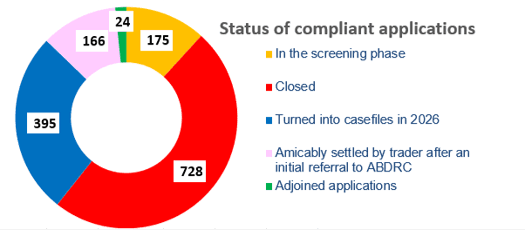
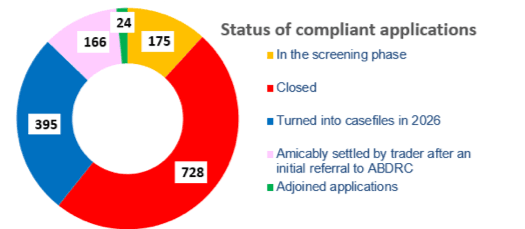
Classification of the 1,458 compliant applications:

  • 395 cases formed in the end of H1 2026 (at the start of 2026, 30 cases were formed from compliant applications received in late 2025);
  • 175 applications in screening phase – documents are being reviewed;
  • 166 applications were settled amicably by the parties, after the consumer having first referred their grievances to ABDRC;
  • 728 cases were closed;
  • 24 applications were adjoined.


Classification of the 395 cases undergoing the procedure with proposed solution/conciliation:

  • 332 resolutions were handed down – the parties came to terms;
  • 26 casefiles are in the processing phase;
  • 32 reports – the parties did not come to terms;
  • 5 cases in which one of the parties withdrew.

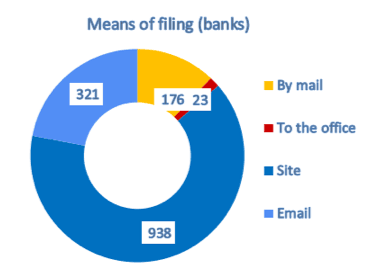
Methods of filing compliant applications – regardless of the referral channel, all compliant applications are entered into the IT application used to manage applications and casefiles:

  • 938 were filed via the app (website);
  • 321 were filed by email;
  • 176 were mailed;
  • 23 were brought to, and registered by consumers with, the office of ABDRC.

NBFIs:

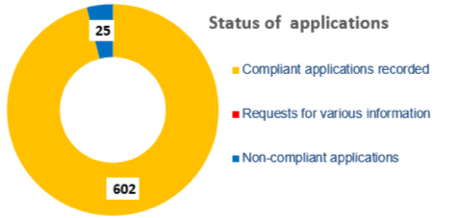
  • 602 compliant applications;
  • 25 non-compliant applications.

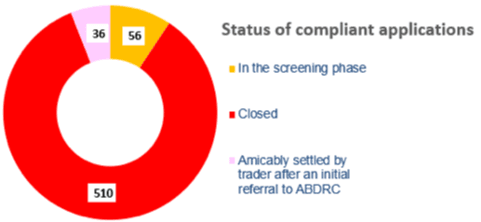
Classification of the 602 compliant applications:

  • 56 applications in the screening phase;
  • 36 applications were settled amicably between NBFIs and consumers, after the consumer having first approached ABDRC;
  • 510 were closed – rejected by the NBFIs.

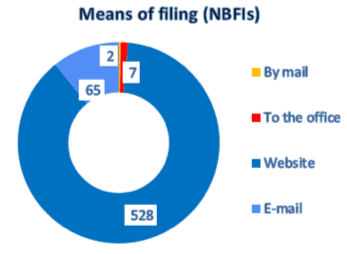
Means of filing compliant applications:

  • 528 were filed via the app (website);
  • 65 were emailed;
  • 7 were brought to, and registered by consumers with, the office of ABDRC;
  • 2 were mailed.

The applications received from consumers covered the following topics:

  • Problems in connection with credit products:
    • Refunds (of fees/commissions, interest);
    • Reduction of loan principal/debt/instalment, or writing off overdue amounts;
    • Rescheduling/refinancing/staging-out;
    • Agreement renegotiation/rebalancing (including for hardship);
    • Finding a solution to address the problems (in general);
    • Shift from ROBOR to IRCC;
    • Conversion of the loan currency;
    • Problems with insurance policies (bancassurance);
    • Interest recalculation;
    • Payment commitments;
    • Maturity acceleration;
    • Removal of certain clauses;
    • Credit Bureau (deregistration from CB).


  • Operational problems:
    • Problems with operation of the ATMs (including refunds);
    • Problems in connection with wire transfers and refunds of transaction fees;
    • Refunds in case of processing errors;
    • Recovery of amount wrongly transferred by consumers (internet banking);
    • Provision of clarifications about calculation of the amounts withdrawn by banks from the credit card account;
    • Other card-related problems (cancellation/name change);
    • Problems in connection with the exchange rate and interests charged when using the cards abroad;
    • Problems regarding inter-banking transfers.


  • Problems related to other types of activities:
    • Problems in connection with forced execution (suspensions/stays of proceedings);
    • Requests to be issued documents (repayment schedules, statements of account, mortgage deregistration, etc.);
    • Refunds of garnished amounts;
    • Fraud committed via bank channels.


The main reason for closing an application is the refusal of traders to have the dispute settle via ADR procedure, and the reasons for closing fall into several categories:

  • Good reasons (main) – the application concerns:
    • deregistration of entries from the Credit Bureau;
    • “First Home” loans;
    • claim assigned to companies which are not regulated by the National Bank of Romania;
    • the state premium under saving-credit contracts.


  • Reasons related to consumers:
    • selection of a trader the business of which is not regulated by the National Bank of Romania;
    • selection of a trader they don’t have commercial relations with;
    • the information/documents required for resolving the application have not been supplied;
    • the consumer does not reply within 90 days, or withdraws during negotiations.


  • Other reasons:
    • pending court proceedings;
    • forced execution procedures have already been initiated;
    • while traders made several offers, all of them were turned down by consumers (before referring the matter to ABDRC), and traders maintain their point of view in the initial answer;
    • lack of grounds (claimed by the trader).

BENCHMARKING:

H1 2025 in figures:

· 1,464 compliant applications – 244 applications per month;

· 373 cases concluded with resolutions/the parties coming to terms (an average of 62 resolutions/month), of 415 cases formed at the end of H1 2025 (an average of 69 cases/month);

· 123 applications settled amicably by the parties* after an initial referral to ABDRC – (an average of 21 amicably settled applications & applications settled directly between the parties/month).


2025 in figures (entire year):

· 2,866 applications – 239 applications per month;

· 911 cases – 76 cases per month;

· 336 applications settled amicably – 28 amicably settled applications/month.

  H1 2026 in figures:

· 2,060 compliant applications – 343 applications per month;

· 332 cases concluded with resolutions/the parties coming to terms (an average of 55 resolutions/month), of 395 cases formed at the end of H1 2026 (an average of 66 cases/month);

· 202 applications settled amicably by the parties* after an initial referral to ABDRC – (an average of 34 amicably settled applications & applications settled directly by and between the parties/month).


CONCLUSIONS:

The ABDRC services continue to be accessed by the Romanians who have problems with banks/NBFIs. Benefits of conciliation: the court proceedings are avoided and the contractual relations between parties continue; short case settlement time (an average of approximately half of a month over the last years, namely 14 days/2024 and 13 days/2025); the fact that the procedure is free of charge for consumers, added to the expertise of conciliators, are all important benefits for both consumers and the financial and banking institutions involved in these negotiations, particularly during economically difficult times, not only at national, but also at international level. In this context, the conclusions drawn for the first six months of 2026 are as follows:

  • During the first six months of 2026, Romanians filed 2,060 applications for negotiation with banks and NBFIs (e., 40% more than in the same period of 2025).
  • The share of applications intended at banks (out of total) went down from 75% to 71%, although banks received more applications in H1 2026 than in H1 2025. The applications intended at NBFIs went up by 63% in the first six months of 2026, as compared to the same period of 2025, and their share out of the total applications increased from 25% (H1 2025) to 29% (H1 2026).
  • Negotiable applications account for 84% of total /H1 2026. In H1 2025, the share of negotiable applications was 78%; in H1 2024, this was 65%.

This is due to a drop from 669 (in H1 2024) down to 321 (in H1 2025), and to 340 (in H1 2026), in the number of applications for deregistration from the Credit Bureau (which cannot be negotiated via ABDRC, but are settled directly by the parties or are closed).

  • The number of cases reached 395/H1 2026 as compared to 415/H1 2025. Consequently, of the 1,240 negotiable applications intended at banks, 395 were turned into negotiation cases, whilst the non-bank financial institutions did not accept any of the 480 negotiable applications they received.
  • In 332 cases, the consumers came to terms with their banks, after having accepted the solution proposed by conciliators.
  • The fact that the traders operating in the financial and banking system continued to welcome the amicable (direct) settlement further to a referral to ABDRC is another way of solving the claims raised by consumers, particularly when these claims concern simple matters and do not necessarily require the intervention/expertise of the ABDRC conciliators: 202 such cases/H1 2026 v 123 such cases at the end of H1 2025. In this case too, banks resorted to this (direct) resolution method more often than NBFIs (166 applications resolved directly by banks and 36 by NBFIs).
  • ABDRC has been running annual awareness, financial education and communication campaigns involving commercial banks, journalists and ABDRC conciliators. Over the recent years, more and more people are finding out about ABDRC’s existence and work from the Centre’s communication and awareness campaigns.
  • ABDRC’s communication strategy for 2026 focuses on the topic of financial education, with a dedicated section on the Centre’s website, where consumers can watch more than 40 podcasts and debates that have been streamed LIVE on topics related to lending, saving, investment and personal budget management. These debates enjoyed the participation of presidents and vice-presidents of commercial banks, conciliators, representatives of the National Bank of Romania, the Romanian Association of Banks and ABDRC, financial analysts and journalists.
  • In January 2026, ABDRC reviewed the profile of the consumer of financial services that approached the Centre in 2024-2025. After having reviewed the 6,434 applications for negotiation with banks/NBFIs filed to ABDRC in 2024 and 2025, we see that the profile of the consumer of financial and banking services is that of a man from the urban environment, mainly from Bucharest or the central part of Transylvania, aged between 41 and 50 years, with a consumer loan in RON, who asks their bank, via an application filled out directly on the website csalb.ro, for a reduction of the costs attached to their loans in progress.
  • In the first part of this year, the ABDRC representatives have continued to meet with high-school students during Săptămâna Altfel (A Different Kind of a Week), and to deliver financial education trainings tailored to their age and needs.
  • The csalb.ro website has a section dedicated to financial education, where one can find narrative and video information that consumers can rely on to make their financial decisions.
  • The informative productions of ABDRC are promoted both on ABDRC’s own channels (website, Facebook, LinkedIn, YouTube, Instagram, and TikTok), and via our media partners: TV and radio outlets, online media, local press, blogposts.
  • Another way of informing consumers is the ABDRC newsletter sent out to consumers of financial services who subscribed to receive this information. A new page was created on the csalb.ro website to allow consumers to sign up for the ABDRC Newsletters.
  • Via its call-centre, ABDRC contacts consumers who want this (having agreed to this in various social media campaigns) by phone. They receive information about an alternative procedure to settle their disputes with banks/NBFIs.
  • On the csalb.ro website, consumers can chat live with the ABDRC’s call centre operators. In the first six months of 2026, the chat was accessed by 304 persons, compared to 165 persons who accessed the chat in H1 2025. The increased need for information among the consumers of financial products and services was also seen in the higher number of people who called ABDRC’s call centre: 1,469 telephone enquiries in H1 2026, compared with 1,025 in H1 2025.
  • At the end of H1 2026, the negotiation procedures involving consumers and banks, and facilitated by ABDRC, resulted into benefits of close to EUR 0.90 million. Thus, the total amount of the benefits obtained (in the more than 10 years of operational activity of the Centre) is approximately EUR 18.4 million.
  • We will continue to employ efforts to make more popular, and ensure media coverage of, the alternative resolution through the courts of law across the country.


The WEBSITE www.csalb.ro provides consumers and legal entities with an online tool whereby conciliation applications can be filed faster and easier. On the first page of the website, consumers are prompted to access this application by filling in an application. On average, it takes one 7 minutes to fill out the application directly on the website csalb.ro.

The documents entered in the registration form are uploaded into the app, and their processing time is approximately one hour. The application was setup in observance of the principles of the General Data Protection Regulation (GDPR).

The Alternative Banking Dispute Resolution Centre (ABDRC) is an independent non-governmental, apolitical, and not-for-profit legal entity of public interest established under the Government Ordinance no. 38/2015 on alternative resolution of disputes between consumers and traders, which transposes at domestic level Directive 2013/11/EU on alternative dispute resolution for consumer disputes and amending Regulation (EC) no. 2006/2004 and Directive 2009/22/EC.


Download the Report