Romanian
 English


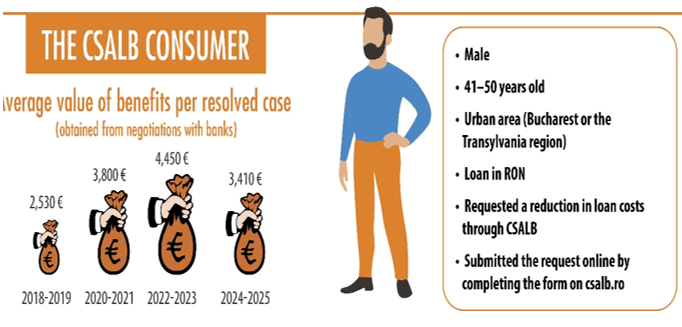
February 25, Bucharest. The last two years have brought significant changes in the profile of consumers who turn to the Center for the Alternative Resolution of Banking Disputes (CSALB). The analysis of the 6,434 negotiation requests sent to CSALB in 2024 and 2025 shows that the typical consumer of financial-banking services is a man from an urban area, mainly from Bucharest or central Transylvania, aged between 41 and 50, who has a consumer loan in lei and who asks the bank, through an application filled in directly on the website csalb.ro, for a reduction in the costs of the ongoing loan. The average benefit obtained in 2024–2025 from each negotiation was EUR 3,410. In 2020–2021, the average benefit per case was EUR 3,810, while in 2022–2023 the highest average benefits were recorded, at EUR 4,450 per negotiation.

Men/Women: Most Romanian consumers who requested a negotiation with a bank/NBFI through CSALB in 2024–2025 were men (53.3%). Over the past two years, their share has decreased compared to 2022–2023 (57.2% men) and 2020–2021 (55.7% men).
Age: Most consumers who turn to conciliation with the bank are over 40 years old. Consumers aged between 41 and 50 account for 28.8% of the total, followed closely by those aged between 51 and 60 (27.8%). Compared to previous years, an increase in the average age of those requesting negotiation can be observed. While in 2019 the dominant age group was 31–40 (32.5%), in 2024–2025 this category represents only 18%.
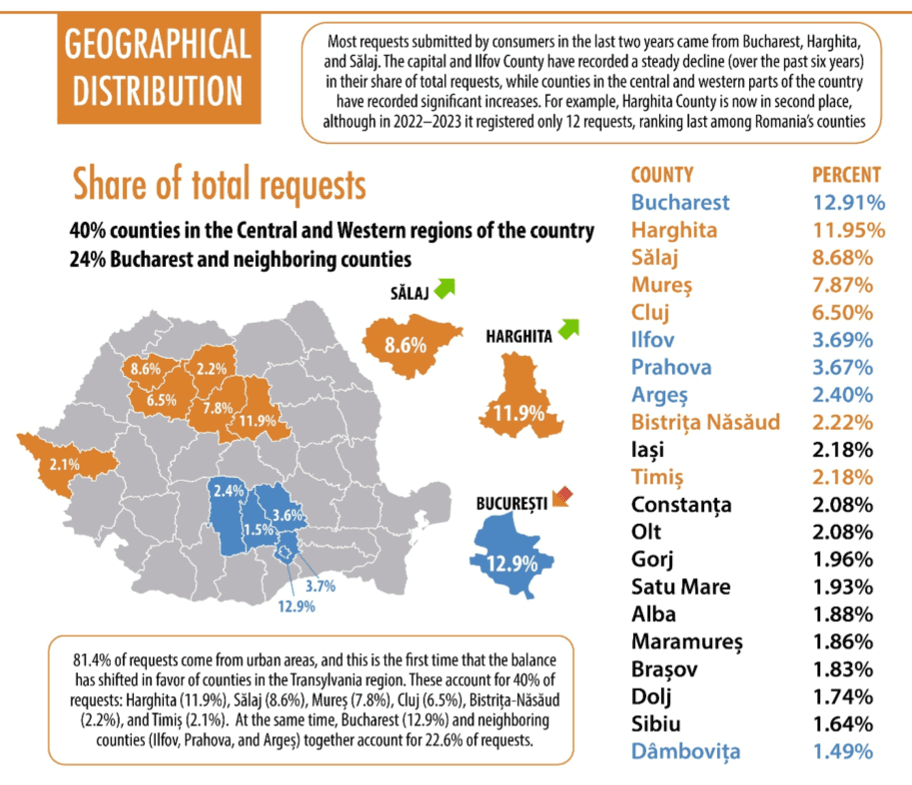
Geographical distribution: Most requests submitted by consumers in the last two years came from Bucharest (12.9%), Harghita (11.9%), and Sălaj (8.68%). A depolarization of requests from the Bucharest–Ilfov area toward counties such as Harghita, Sălaj, Mureș, and Cluj can be observed. Requests from these areas are often submitted by consumers’ lawyers seeking to avoid court proceedings or already involved in litigation with banks. In 2018–2019, Bucharest accounted for 28% of all requests, and in 2022–2023 the area around the capital concentrated 40% of requests (18.7% from Bucharest, 8.5% from Argeș, 5.6% from Ilfov, 4.5% from Prahova, and 3.3% from Dâmbovița). In the last two years, counties in central Transylvania accounted for 40% of requests: Harghita (11.9%), Sălaj (8.6%), Mureș (7.8%), Cluj (6.5%), Bistrița-Năsăud (2.2%), and Timiș (2.2%). At the same time, Bucharest (12.9%) and neighboring counties (Ilfov, Prahova, Argeș, Dâmbovița) together account for 24% of requests. In 2025, CSALB also received requests from Romanians living in Italy, Germany, Australia, and North Macedonia.
Issues reported in requests to CSALB: CSALB received over 6,400 requests in 2024 and 2025, with 2024 being the year with the highest number of applications: 3,568. Over 65% of requests in the past two years concerned the reduction of credit contract costs (through negotiating fees and interest rates). Problems related to ATMs or deposits accounted for 12.5% of requests. Cases where consumers invoked social issues (income reduction, increased expenses, medical situations) represented 6.5% of the total. Disputes already filed in court between consumers and banks (later settled amicably through CSALB) represented 5.2% of the total. Problems related to enforcement proceedings or cases where consumers negotiated repayment commitments for overdue debts together account for more than 5% of requests.
For the first time, requests for conciliation following fraud on banking channels also entered the ranking of most frequent complaints.

Loan currency: Most loans referred to in conciliation requests are in lei (82.8% vs. 86.6% in 2022–2023 and 84.2% in 2020–2021). Compared to the previous period (2022–2023), there has been an increase in requests related to euro-denominated loans: from 9.1% in 2022–2023 to 14.3% at the end of 2025.
CHF-denominated loans represent only 1.9% of total requests, compared to 3.8% in the previous period.
Method of submission: Currently, CSALB’s activity is carried out 84.8% online (through the application on csalb.ro and by email). Most consumers complete the request for negotiation with the bank/NBFI directly on www.csalb.ro using the IT application. Compared to previous years, there has been a significant increase in requests sent by post (from 1.1% in 2022–2023 to 13.7% in the last two years).