Romanian
 English



During the first nine months of 2025, as many as 812 consumers went through the entire conciliation process: application filing, negotiation, final resolution ó a solution accepted by both parties (in 595 cases), or reached an amicable settlement directly with their banks/NBFIs, having first approached ABDRC (in 217 cases).
In the first nine months of the year, 89 court cases were terminated because the parties wanted and managed to find an amicable solution with the help of ABDRC.
The number of compliant applications registered in the first nine months of the year stands at 2,121 applications, with both the number of applications to banks and the number of applications to NBFIs lower this year compared to the same period last year, amid a decrease in the volume of requests for de-registration from the Credit Bureau. Some consumers continued to experience genuine difficulties in making the due payments, and these justified circumstances required identification of solutions to rebalance the contractual obligations (with the applications being submitted directly to creditors, or via ABDRC).
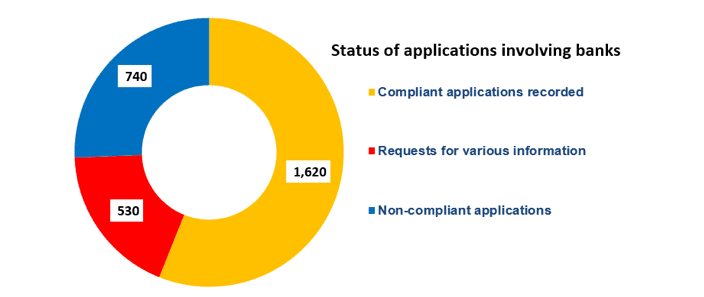
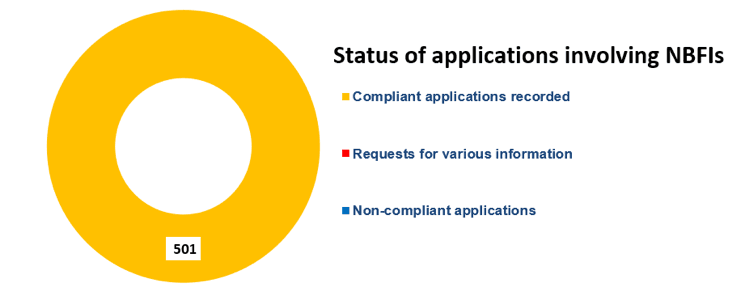
Of the total number of applications received before the end of Q3 2025, 1,620 concerned different issues in relation with banks, whereas 501 concerned different issues in relation with NBFIs.
Thus, the share of applications to NBFIs fell below last year’s reference period: from 26.6% of total/Q3 2024 down to 23.6% of total/Q3 2025.
Aggregately, the share of applications intended at banks increased compared to last year’s reference period: 73.4% of the total/at the end of Q3 2024, and 76.4% of the total/Q3 2025.
At the end of Q3 2025, we see 500 applications for deregistration from the Credit Bureau (CB) (282 intended at banks + 218 intended at NBFIs), while the number of this type of applications recorded at the end of Q3 2024 was 803. Thus, in this statistical slot, we need to highlight also that, in the first nine months of this year, the number applications for deregistration from the Credit Bureau (CB) stayed flat compared to last year (a decrease by approximately 38%).
It should be reminded that most of the applications concerning issues in relation to the Credit Bureau, the First Home programme or assigned loans are closed because, on a case-by-case basis, these are governed by a special piece of legislation which leaves but limited or even no room whatsoever for negotiation.
The number of casefiles formed at the end of Q3 2025 reached 686. Two casefiles were formed in relation to a NBFI and 684 were formed in relation to banks. By way of comparison, 825 casefiles were formed in the first nine months of 2024 (one single casefile in relation to NBFIs). Of the casefiles formed this year and settled until the end of the reference period, 595 concluded with a resolution (the parties accepted the solution proposed by the conciliator), while other 60 casefiles are still being processed (at the end of Q3 2025). In 20 cases, one of the parties rejected the solution rendered by the conciliator and a report was issued, whereas in 11 cases, one of the parties withdrew from the procedure.
The number of resolutions handed down in the first nine months of this year is 595, compared to the figure reported for the same period of last year, i.e. 721 resolutions (during the two periods under review, being Q3 2025 and Q3 2024, the share of resolutions out of the total solutions is 96% in both years).
Furthermore, before the end of the Q3 2025, 217 applications were settled amicably by traders after the respective cases having been referred to ABDRC (traders negotiated directly with consumers), broken down as follows: 176 applications settled amicably with banks, and 41 applications settled amicably with NBFIs.
At the end of Q3 of this year, we counted 1,318 enquiries made by phone, and 293 persons/consumers accessed the chat function available on the ABDRC website.
A breakdown of the applications by traders looks as follows:
BANKS:
- 1,620 compliant applications;
- 740 non-compliant applications;
- 530 requests for miscellaneous information.
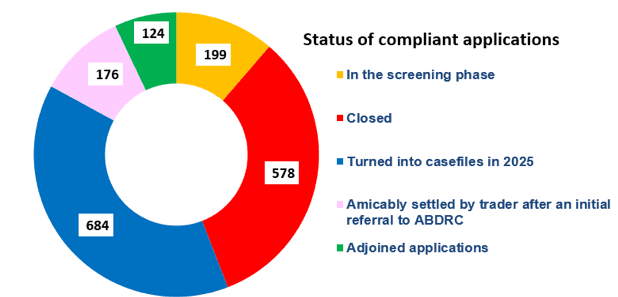
Classification of the 1,620 compliant applications:
- 684 casefiles formed in the end of Q3 2025 (at the start of this year, 141 casefiles were formed from compliant applications received in late 2024);
- 199 applications in screening phase – documents are being reviewed;
- 176 applications were settled amicably by the parties, after the consumer having first made a referral to ABDRC;
- 578 cases were closed;
- 124 applications were adjoined.
Classification of the 684 casefiles undergoing the procedure with proposed solution/conciliation:
- 594 resolutions handed down – the parties came to terms;
- 60 cases in the processing phase;
- 19 reports – the parties did not come to terms;
- 11 casefiles in which one of the parties withdrew.
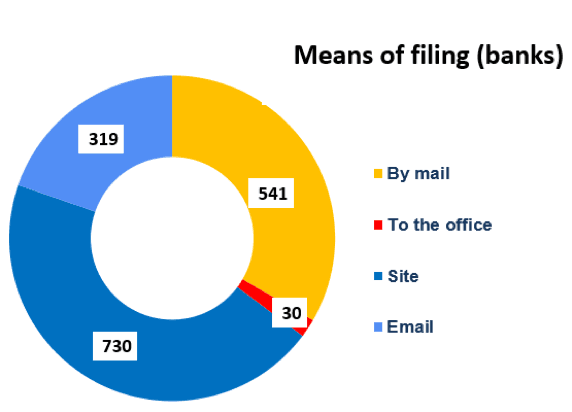
Methods of filing compliant applications – regardless of the referral channel, all compliant applications are entered into the IT application used to manage applications and casefiles:
- 730 were submitted via the app (website);
- 319 were e-mailed;
- 541 were mailed;
- 30 were brought to, and registered by consumers with, the office of ABDRC.
NBFIs:
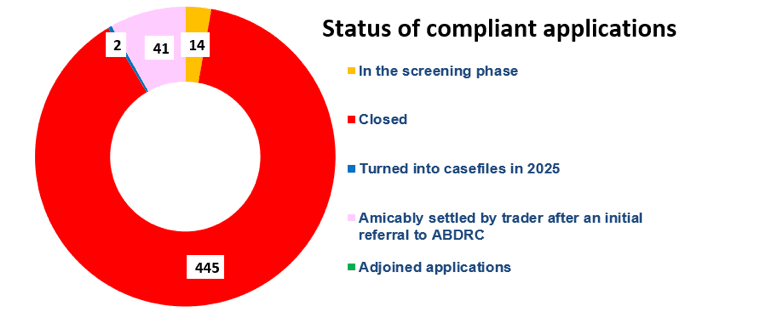
- 501 compliant applications.
Classification of the 501 compliant applications:
- 2 casefiles (one casefile formed in 2025 from one application received before the end of 2024);
- 14 applications in the screening phase;
- 41 applications were settled amicably between NBFIs and consumers, after the consumer having first approached ABDRC;
- 445 were closed – rejected by the NBFIs.
Qualification of the 2 casefiles undergoing the procedure with proposed solution/conciliation:
- 1 resolution rendered – the parties reached an agreement;
- 1 report – the parties failed to reach an agreement.
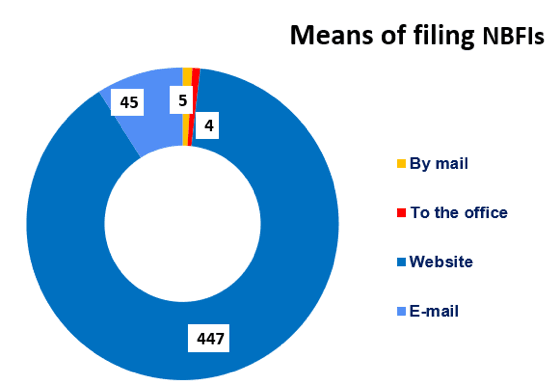
Means of filing compliant applications:
- 447 were submitted via the app (website);
- 45 were emailed;
- 5 were mailed;
- 4 were brought to, and registered by the consumer at, the office of ABDRC.
The applications received from consumers covered the following topics:
- Problems in connection with credit products:
-
- Refunds (of fees/commissions, interest);
- Shift from ROBOR to IRCC;
- Reduction of loan principal/debt/instalment, or writing off overdue amounts;
- Rescheduling/refinancing/staging-out;
- Agreement renegotiation/rebalancing (including for hardship);
- Finding a solution to address the problems (in general);
- Conversion of the loan currency;
- Problems with insurance policies (bancassurance);
- Interest recalculation;
- Payment commitments;
- Maturity acceleration;
- Removal of certain clauses;
- Credit Bureau (deregistration from CB).
- Operational problems:
-
- Problems with operation of the ATMs (including refunds);
- Problems in connection with wire transfers and refunds of transaction fees;
- Refunds in case of processing errors;
- Recovery of amount wrongly transferred by consumers (internet banking);
- Provision of clarifications about calculation of the amounts withdrawn by banks from the credit card account;
- Other card-related problems (cancellation/name change);
- Problems in connection with the exchange rate and interests charged when using the cards abroad;
- Problems regarding inter-banking transfers.
- Problems related to other types of activities:
-
- Problems in connection with forced execution (suspensions/stays of proceedings);
- Requests to be issued documents (repayment schedules, statements of account, etc.);
- Refunds of garnished amounts;
- Mortgage deregistration;
- Fraud committed via bank channels.
The main reason for closing an application is the refusal of traders to have the dispute settle via ADR procedure, and the reasons for closing fall into several categories:
- Good reasons (main) – the application concerns:
- deregistration of entries from the Credit Bureau;
- “First Home” loans;
- claim assigned to companies which are not regulated by the National Bank of Romania;
- the state premium under saving-credit contracts.
- Reasons related to consumers:
- selection of a trader the business of which is not regulated by the National Bank of Romania;
- selection of a trader they don’t have commercial relations with;
- the information/documents required for resolving the application have not been supplied;
- the consumer does not reply within 90 days;
- the consumer withdraws.
- Other reasons:
- pending court proceedings;
- forced execution procedures have already been initiated;
- traders made several offers, but all of them were turned down by consumers (before approaching ABDRC), and traders maintain their point of view in the initial answer sent to consumers;
- lack of grounds (claimed by the trader).
BENCHMARKING:
| Q3 2024 in figures:
• 2,839 compliant applications – 315 applications per month; • 721 casefiles concluded with resolutions/the parties coming to terms (an average of 80 resolutions/month), of 825 casefiles formed at the end of Q3 2024 (an average of 82 casefiles/month); • 246 applications settled amicably by the parties* after an initial referral to ABDRC – (an average of 27 applications settled amicably & directly between the parties/month). 2024 in figures (entire year): · 3,568 applications – 297 applications per month; · 1,078 casefiles – 89 casefiles per month; · 301 applications settled amicably – 25 amicably settled applications/month. |
Q3 2025 in figures:
· 2,121 compliant applications – 236 applications per month; · 595 casefiles concluded with resolutions/the parties coming to terms (an average of 66 resolutions/month), of 686 casefiles formed at the end of Q3 2025 (an average of -76 casefiles/month); · 217 applications settled amicably by the parties* after an initial referral to ABDRC – (an average of 24 amicably settled applications & applications settled directly between the parties/month).
|